
Elbows Up
This isn't business as usual.

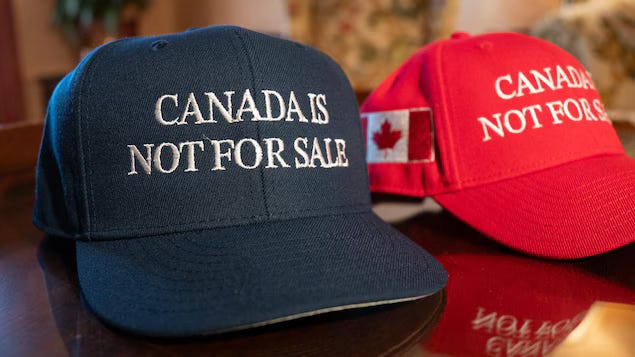
As a City Planner who started out in the U.S. and now lives and works in Canada, I belong to the professional planning organizations in both countries. For Canada that’s the Canadian Institute of Planners (CIP) and in the U.S. it’s the American Planning Association (APA). APA has an International Division that I belong to and they recently sent out a survey to their members asking about how the current U.S. Presidential Administration policies and actions are impacting us professionally and personally. This was my response:
From a professional standpoint, the tariffs and threatened tariffs on Canada are: 1) negatively affecting the value of Canadian currency, 2) negatively affecting local businesses that export goods to the U.S. and depend on goods and manufacturing parts imported from the U.S. (approximately 80% of the manufacturing exports in the community I work for have been to the U.S.). This makes planning for retention of businesses and manufacturing operations precarious.
All of this makes financial planning at the Federal, Provincial, and local government levels nearly impossible. Worst case scenarios have Canada heading into a deep recession if not depression. As a professional this could mean that my job and / or the jobs of my staff are at risk. For the city I work for, it would mean a reduced ability to provide critical public services such as Policy, Fire, water provision and treatment, sewer treatment, and garbage collection. For the citizens who live in the city I work for, this could mean increased risk of homelessness and overcrowding - exasperating the housing crisis.
In 2021, the city I work in flooded due to a river in Washington State flooding across the national border with Canada and breaching local dike systems. This flooding caused billions of dollars of damage that the city is still trying to recover from as well as highlighting some weaknesses in food transportation, technology, and hazard response systems. International cooperation is critical to prevent future flooding events and other climate-change related emergencies, but reductions in U.S. federal staffing, and reduced access to U.S. federal data on climate change, weather, and emergency management have and will hinder our ability to progress on cross-border solutions to issues such as these.
From a personal perspective, I am a dual citizen with the U.S. My parents, adult children and all of my extended family live in the U.S. My husband and his extended family are all Canadian.
As a U.S. citizen, I am very concerned that the President of the United States is violating the constitution by refusing to spend money appropriated by Congress. There is an on-going constitutional crisis going on in the U.S. and the system has thus-far shown that it is not up to the challenge.
I am concerned my private information has been accessed by DOGE without authorization and continues unabated. I'm concerned that the purging of federal employees without much thought or oversight will result in great harm to the U.S. and other countries. I'm also concerned about data that citizens and professionals have previously relied on being unavailable and / or unreliable. Whatever progress has been made in Housing, Health, Climate, or Transportation can only be greatly hampered by such a sudden reduction in staff, data maintenance, and budget.
The references to Canada becoming the 51st state are considered an existential threat to the Canadians I live and work with. The U.S. about-face on support for Ukraine and consequential attempt to force Ukraine to give over mineral rights appears to many Canadians (and myself) as the long-term plan the administration has for Canada - break our economy and force us to hand over rare minerals. All of this makes Canadians feel that we are being threatened by a country that has previously been our ally. The mental load of this reality seeps into everything we do. My pacifist husband has recently started considering getting a gun in case the U.S. or the domestic terrorists they now seem to turn a blind-eye to, attack our country with weapons.
Two of my siblings in the U.S. are federal employees who are worried about losing their jobs.
My adult son in Washington State has depended on Medicaid to help diagnose and treat his Multiple-Sclerosis. We are worried that he will lose access to Medicaid.
My father and stepmother in Oregon are both retired and receiving social security. My mother has not been able to retire yet but will depend on Social Security if she hopes to retire. We are all concerned Social Security will be reduced or eliminated in which case my mother would need to keep working as long as her health allowed. And then she would need to rely on Medicare, which also seems to be at risk.
My son has a daughter whose mother is an undocumented immigrant living in a state that has been hostile toward undocumented immigrants. We are concerned that my granddaughter and her mother may be arrested, detained, separated and / or deported as happened in the first Trump administration and which the current one is currently undertaking.
While crossing the Canadian border to visit my family has been relatively easy in the past, I have recently been asked questions by U.S. border agents that I hadn't been asked before - about why I moved to Canada. I am starting to think twice about visiting family in the U.S. Vacations there are out of the question for the foreseeable future which seems to be the sentiment Canada-wide. I have advised my family that if they visit, that they not bring any gifts as the border agents seem to be pulling people over, searching their goods, and charging taxes that were either previously overlooked or now necessary because of the tariffs.
Overall, I would say that the stress and anxiety related to all of the changes and threatened changes are the most difficult thing to live with in the short-term but the medium and long-term impacts could be devastating on many levels.